

Stemma and Manuscript Groups
This edition refers to manuscript groups o a b cd ungrouped. The relationships between these groups are summarized in this stemma (to be published in Forthcoming), which sets out the relationships, as we have determined them, for the c. sixty full copies of the Tales:
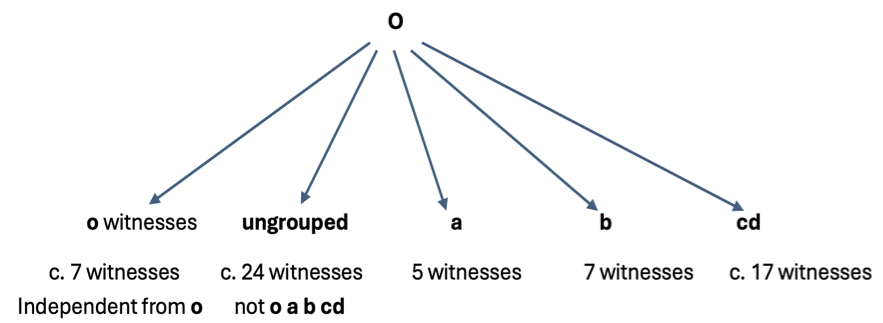
In our analysis these relationships are stable across all sixty witnesses across the whole length of the Tales. There are exceptions: notably, Ch moves away from the o group for the Cook's Tale, El moves away from o in the first half of the Wife of Bath's Prologue, and manuscripts move irregularly between the o, ungrouped and cd groups. Compare Robinson 2026, p. 26 for the assertion that the world is a messy place, and accordingly stemmata are messy things. However, the broad consistency with which this stemma appears to hold across the whole Tales persuades us that there is a single textual history for the whole text. This runs against Dempster's assertion, based on her reading of Manly and Rickert, that each part of the Tales has a separate textual history, some twenty-five histories in all, with each separate history dependent on the existence of part-exemplars distributed before Chaucer's death. This view requires the existence of over two hundred part-exemplars, not one of which have survived. Our single stemma for the whole Tales makes our task as editors far easier. We do not aim at strict editing by recension, which would require us to hypothesize that every extant manuscripts must descend from separate copies below the ancestor ('hypearchtype'). Robinson's Anglia article argues that in a textual tradition of any size, strict recension is likely impossible, a conclusion which follows also from the editors' "Manuscripts with Few Significant Introduced Variants" Ecdotica article (2018.) Like Ralf Plate, we describe our editing as "stemmatically informed".
The five groups into which our stemma divides the manuscripts and pre-1500 print texts of the tales are as follows:
- o: in strict stemmatic terms (for example as defined by Maas and his followers) this is not a "Genetic Group". The manuscripts in this group are not defined by mutual possession of errors introduced by a shared ancestor below the archetype but rather by retention of original readings typically replaced by other manuscripts. We identify such readings by a this variant search, using the VBase tool:
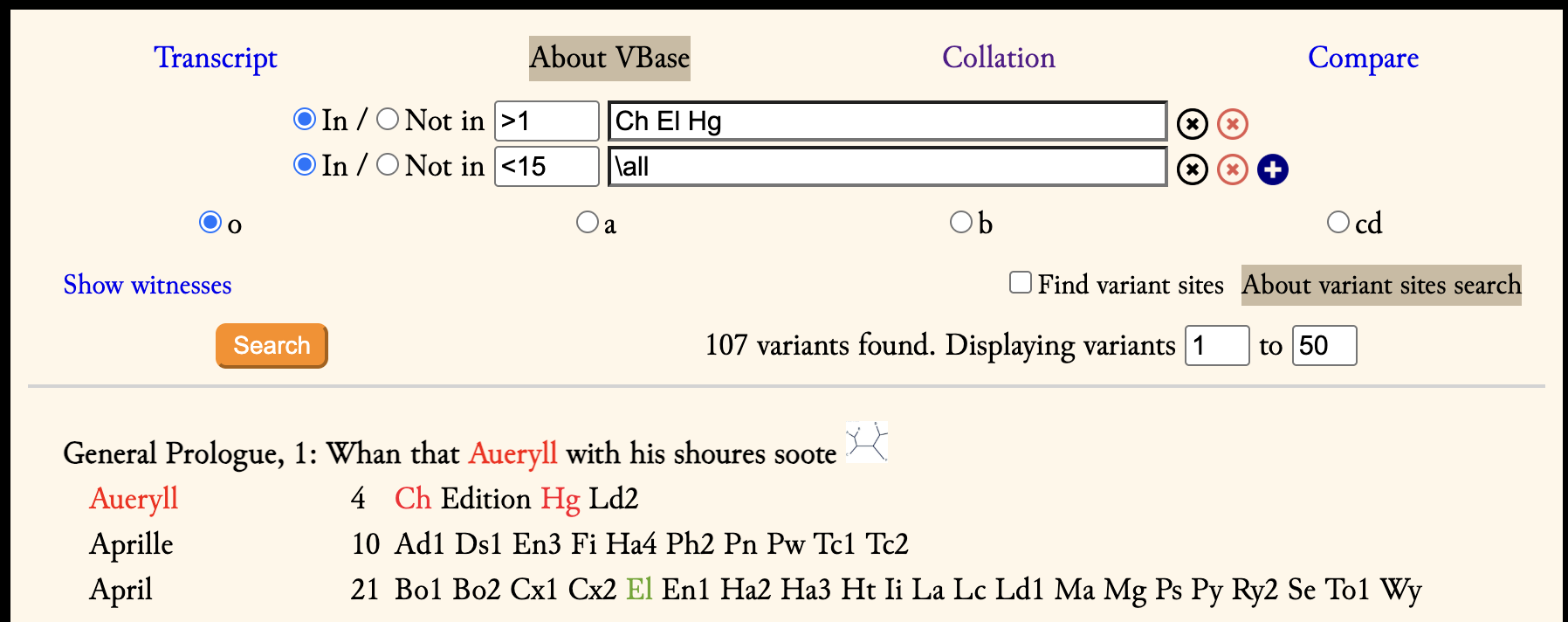
- The logic behind this search is that the three manuscripts Ch El Hg are specially likely to preserve original readings: hence the first line, that we are looking for readings in at least two of those manuscripts. Further, if these readings are typically replaced elsewhere in the tradition, they will appear in less than fifteen manuscripts, and thus the second line. You can do this search for yourself for the General Prologue here. Typically, between one in every six to ten lines contains an o variant. Although theoretically meaningless for recension, for us as editors these are exactly the manuscripts most likely to contain original readings not present elsewhere. As this search implies, the three manuscripts Ch El Hg (see below) are the core of the o manuscripts group. They are typically joined by Bo2 Gg and the pair Ad3-Ha5, by Cx2 when it differs from Cx1, and less often by Ha4 Ht Py To1 Cp Dd Ps.
- ungrouped: The ungrouped manuscripts are, to put it most simply, manuscripts which do not typically retain readings likely present in o (and thus, not o) and do not have the readings characteristic of the a b cd genetic groups (and thus, not a b cd). Several manuscripts appear to move between o and ungrouped, notably Ha4 Py To1; in some tales a few ungrouped manuscripts appear to form affiliations which dissolve in other tales; in others, ungrouped manuscripts join one of the genetic groups a b cd. Typically, Ha4-Ii Ad1-En3 Bo1-Ph2 Fi Mc-Ra1 Hk Py Ps, sometimes with some of Ht To1 Bw Tc1 Ra3 Nl Ra2 Ha3 Ln Si Dl, are ungrouped.
- a b cd: We agree with Manly and Rickert on the existence of the genetic groups (that is, manuscripts which descend from a common ancestor below the original) they label a b c d, with the exception that we see their c d as a single group, cd. The smaller a and b groups are remarkably stable; the larger cd group less so. The members of a are the two pairs Cn-Ma and Ds1-En1 along with Dd, which also retains many o readings not found in the other four. (c. 5-7 mss with El Ch Ln occasionally joining). The members of b are Cx1 He Tc2, with Tc2 a likely copy of Cx1. A second group within b is made up of Cx2 Pn Wy, diverging from Cx1-He-Tc2 by Caxton's corrections of Cx1 from what appears to have been a now lost o manuscript (Bordalejo 2002 and 2014) (c. 6-10 mss). The large cd group is made up of Cp Mg-Lc Gl-Mm Fi La Ld1 Pw Ry1 Ry2 Se Sl1 Sl2, sometimes with Ln Ld2 Ha3 Tc1 Ra3 Ra1-Mc-Tc1 Ra2 Nl Ha2 Ry1 Ps Bw Dl En2 To1 Ph3. Cp appears nearest to the cd hyparchetype, and frequently retains readings from o lost in other cd manuscripts. (c. 20-30 mss)
Among all the manuscripts of the Tales, three stand out for the excellence of their text and for their closeness not just in readings but also in fine details of spelling. Two of the three, El and Hg, have been long regarded by scholars as key to the tradition. We agree with this assessment and argue that their excellence derives from both manuscripts being direct copies from the o materials made by a single scribe known as "Scribe B" (Parkes and Doyle 1978). Scribe B appears to have been specially close to Chaucer (thus Mooney on Adam Pynkhurst; cf. Warner 2018). Ch has been long known to share many good readings with Hg and El. Our work has confirmed that this closeness extends to precise detail of wording and spelling, with analysis of the spelling of all three manuscripts showing that they are so close that it appears that Ch is a copy of a third manuscript, alongside El and Hg, also written by Scribe B (Forthcoming and 2025). Accordingly we regard Ch as deserving the same regard among editors as has been traditionally given to El Hg. This figure summarizes the relationship between Ch El Hg and o: