

The Book of the Tales of Canterbury
The first words at the top of the first page of the Hengwrt manuscript (Hg), accepted as the most important single manuscript of Chaucer’s work, are:
Here bygynneth the Book of the tales of Caunterbury
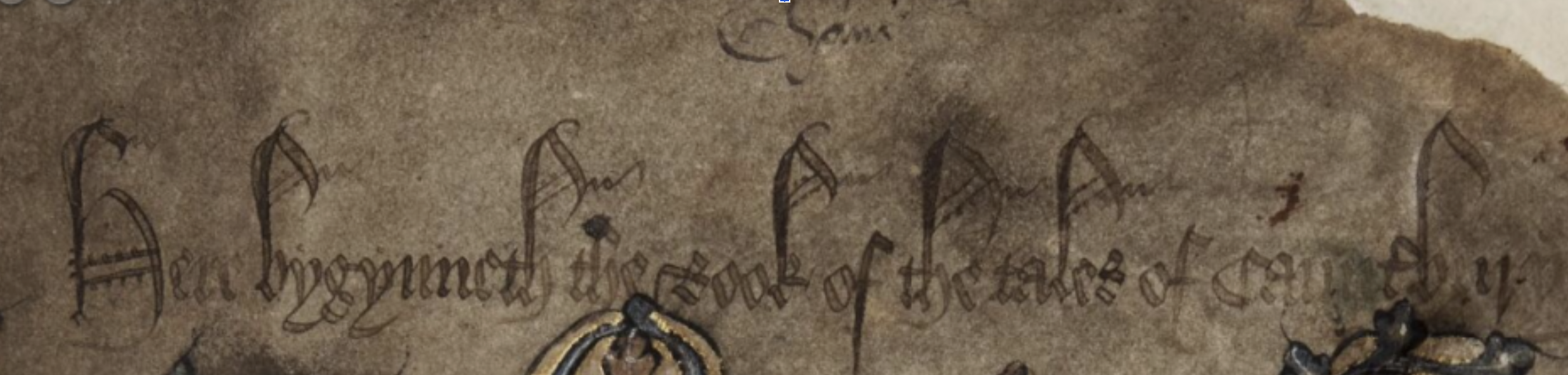
These words are written by the main hand of the manuscript, in the same yellowish ink used by this scribe for what seems to be the last parts of the manuscript he wrote, notably the links between the tales of the Squire Merchant and Franklin. It is as if the last act of the scribe was to write the title of the whole work at its very beginning.
Indeed, the testimony of every manuscript which gives a title agrees with this wording. It is “the book of the Tales of Canterbury” in the fifteen manuscripts (and two incunables) which give the title in the explicit to the whole collection, at the very end of the text:
Heere is ended the book of the tales of Caunterbury
Thus, the Ellesmere manuscript (El)

Caxton’s "prohemye" to his second edition (c.1483) also names the work as "the book of the tales of cauntyrburye". At some places, the initial "The book of" is elided. The list of Chaucer’s works in the Retraction (1012) names "the book of Troilus" and other books, "of seint Valentynes day", then "the Tales of Caunterbury" and "the book of the Leon". The copy of John Shirley’s introduction to the text, preserved in Harleian 7333, describes the work as "þe tales of Caunterburye wiche beon Compilid in þis boke". In no manuscript is the work described as "The Canterbury Tales”.
The first appearance of the phrase "Canterbury Tales" is in Richard Pynson’s c. 1492 print edition, as a title placed before the first lines of the General Prologue:
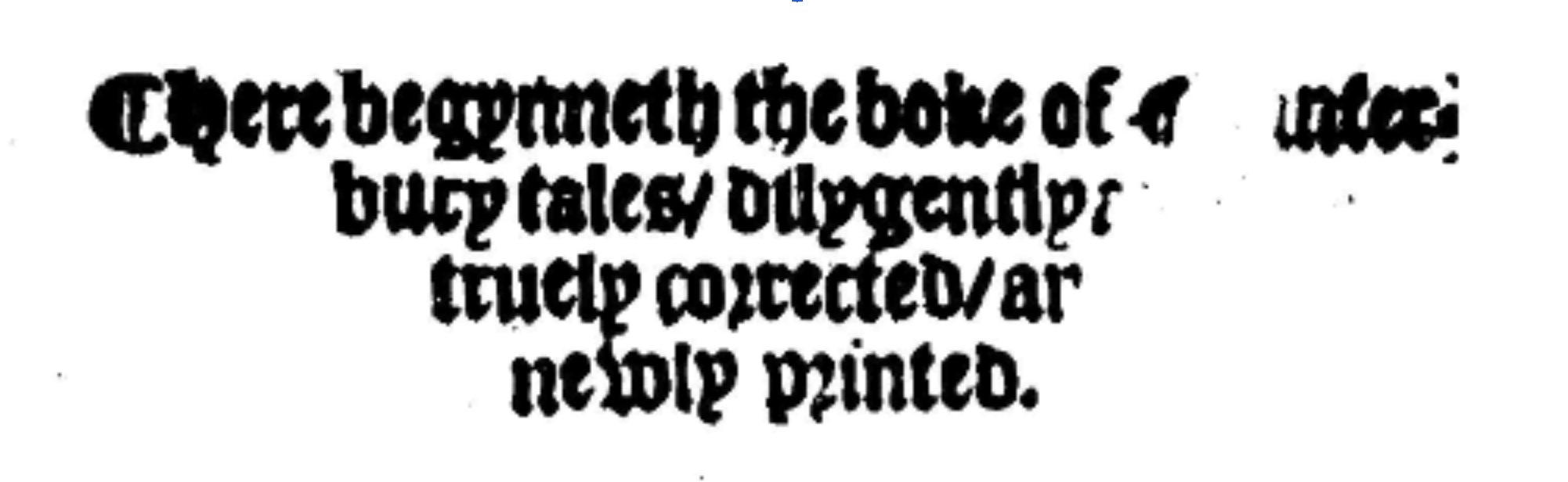
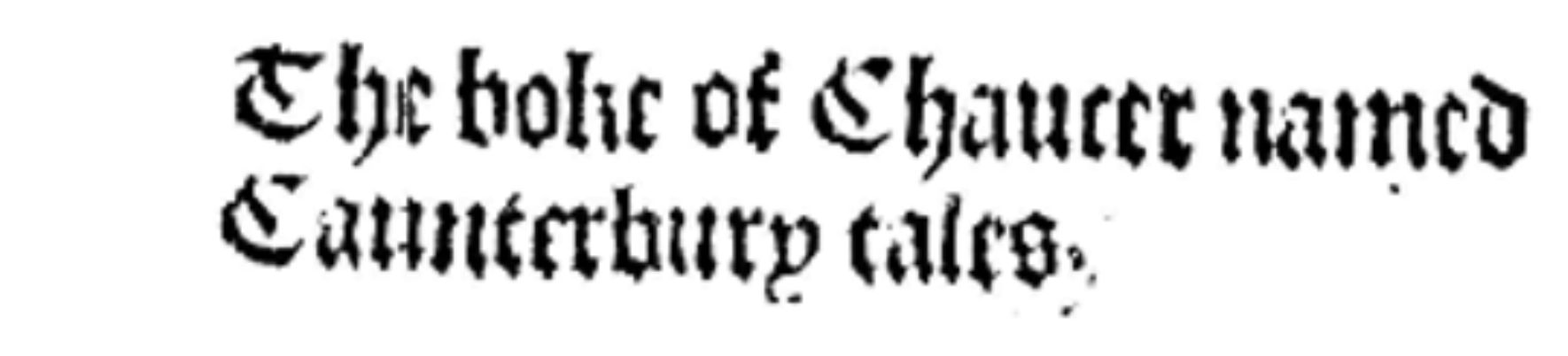
Here, the phrase "Canterbury Tales" is linked with "boke". Wynkyn de Worde modifies the wording to the "boke of Chaucer named Caunterbury Tales" in his 1497 printing, and makes the title more prominent by having it appear alone on a page before the start of the main text:
The first appearance of the modern form of the title "Canterbury Tales", without the qualifying "Book of", is in William Thynne’s 1532 edition of "The Workes of Geffray Chaucer".

"The Caunterbury Tales" is listed first in a table of contents on page a iii r for the whole volume, following Thynne’s "Preface", with entries for the "Romant of the Rose", "Troylus and Creseyde" and others following in this table of contents. The next page lists the parts of the Tales in a further table of contents, beginning with "The P[ro]logues of the Canterbury tales." Thynne’s edition was reprinted in 1542, and both Stow’s 1561 and Speght’s 1598 edition follow the same formula, of "Preface", then a table of contents for the whole volume with "The Canterburie Tales" appearing first, and a second table of contents just for the Tales following, beginning with "The Prologues of the Canterberie Tales". None of these three – Thynne, Stow or Speght -- reprint Caxton’s "Prohemye". These three editions defined how Chaucer was read during the renaissance in England. All three editions and their reprints, both in their various tables of contents and "Prefaces" refer to the Tales as "the Canterburie Tales" (thus, Speght on f. c.i.r). That title has persisted into the modern day, despite it appearing in no document until over a hundred years after Chaucer’s death. Accordingly, we restore the title to that known throughout the first century and longer of the Tales.